AirTag Won't Fit in Your Wallet — Here's a 1.7mm Card That Actually Does
By InCard Team · July 28, 2026 · 8 min read
AirTag Won't Fit in Your Wallet — Here's a 1.7mm Card That Actually Does
Apple's AirTag is a good tracker. It is also a disc that is 8mm thick — about the same height as a stack of five credit cards. No matter how you position it, fold it, or wish at it, it will not slide flat into a standard wallet slot. That is not a setup problem or a compatibility issue. It is a geometry problem, and Apple has no plans to fix it.
If you have an iPhone and you want to track your wallet, you need a card-shaped tracker. If you also have an Android phone — or share a household with someone who does — you need one that works on both networks.
The InCard Finder is 1.7mm thick, credit-card sized (84.6 × 53mm), IP68 waterproof, and runs for up to 5 years on a sealed battery with no charging and no subscription. It works with Apple Find My or Google Find Hub, selected at setup.
That is the short answer. Here is why the thickness gap matters more than most reviews explain.
Why AirTag Will Never Fit in a Wallet
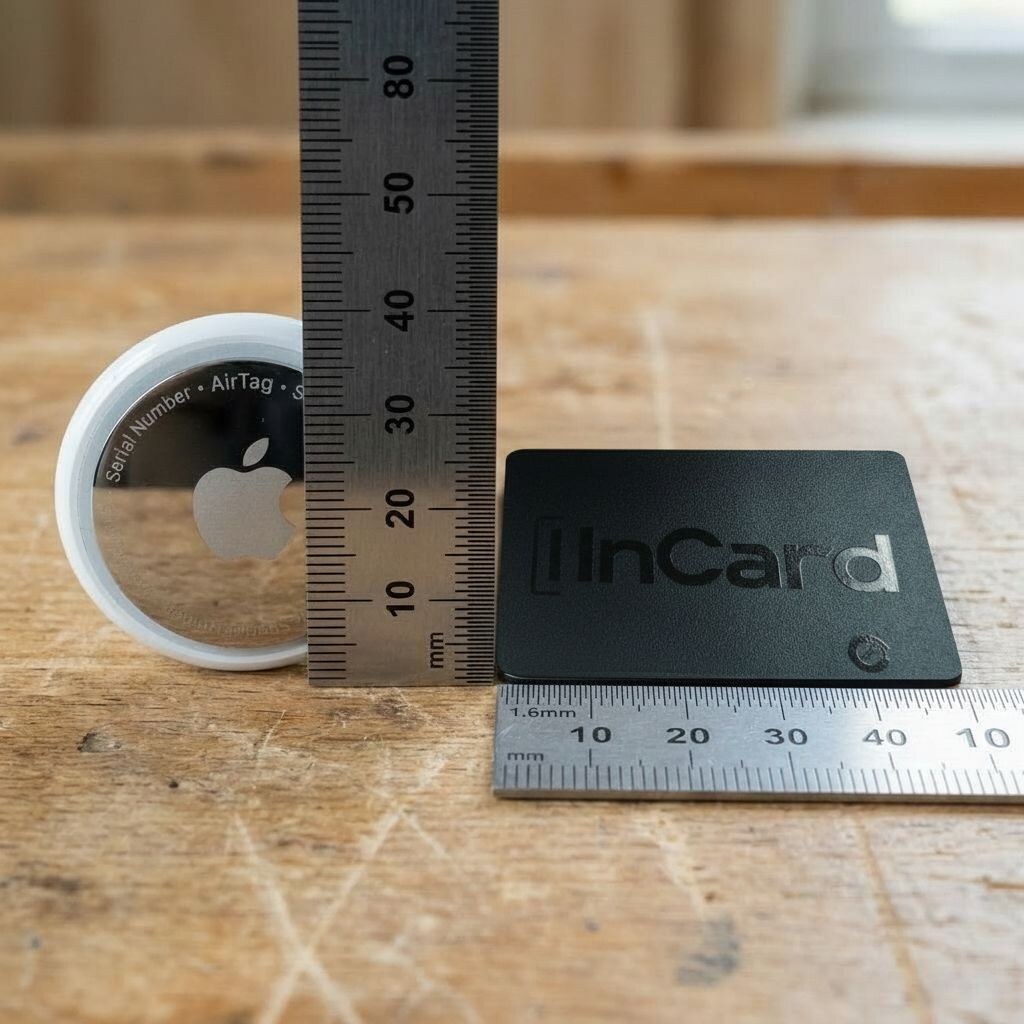
The AirTag's 8mm depth is not a design oversight. It is structural. Inside that disc is a CR2032 coin cell battery, a U1 ultra-wideband chip, a speaker, and a circular PCB that has to accommodate all of them. There is no slimmer way to stack those components at consumer price points. The disc shape also maximises the antenna aperture for Bluetooth range.
The result: the AirTag is roughly the height of a pencil eraser. Wallet card slots are designed to hold cards that are 0.76mm thick (standard ISO 7810). Even a generous billfold slot will close uncomfortably — if at all — around something 10x that depth. Third-party AirTag wallet inserts exist (dedicated card holders with a moulded AirTag pocket), but they add bulk to solve a bulk problem, and they only work with iPhone.
Card-form tracker hardware has to make different trade-offs. No UWB chip — that is the honest concession. AirTag's Precision Finding, which uses UWB to guide you to within centimetres of the tracker, is genuinely useful and InCard Finder does not have it. If you regularly lose things in large, cluttered spaces and you have an iPhone, that matters.
What card trackers trade away in UWB precision, they recover in form factor, battery architecture, and in InCard Finder's case, network flexibility.
What a Card Tracker Actually Looks Like Inside a Wallet
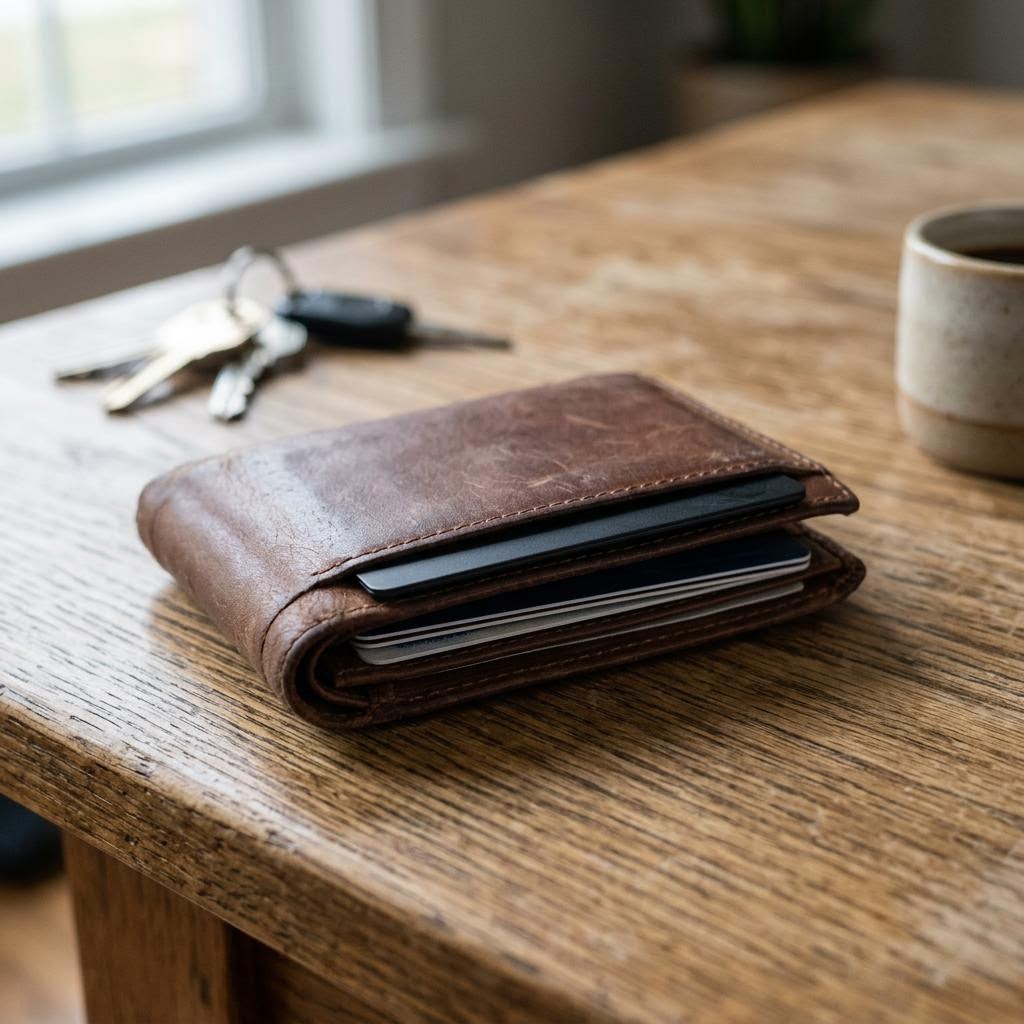
InCard Finder matches a standard credit card in length and width: 84.6 × 53mm. At 1.7mm, it is thicker than a bank card (0.76mm) but thinner than two cards stacked. It slides into any card slot and the wallet closes flat.
A few practical notes:
- It is not a GPS tracker. Like AirTag, it uses Bluetooth and the crowd-sourced Find My / Find Hub network. When another phone passes near your lost wallet, it anonymously relays the location. In any major city, that happens quickly.
- Sound alert is 90dB at up to 170m (550ft) Bluetooth range — useful when the wallet is somewhere nearby and you need to hear it.
- IP68 rated (1.5m fresh water, 30 minutes). If your wallet goes through a wash cycle, the tracker survives. This is a Finder-specific spec — the Tagigo tag is not waterproof.
- Sealed battery, no charging. The lithium-MnO₂ cell is non-replaceable and rated up to 5 years on Google Find Hub or up to 3 years on Apple Find My. When it expires, you replace the card. There is no charging cable to remember.
Dual-Network: The Detail That Matters for Mixed Households
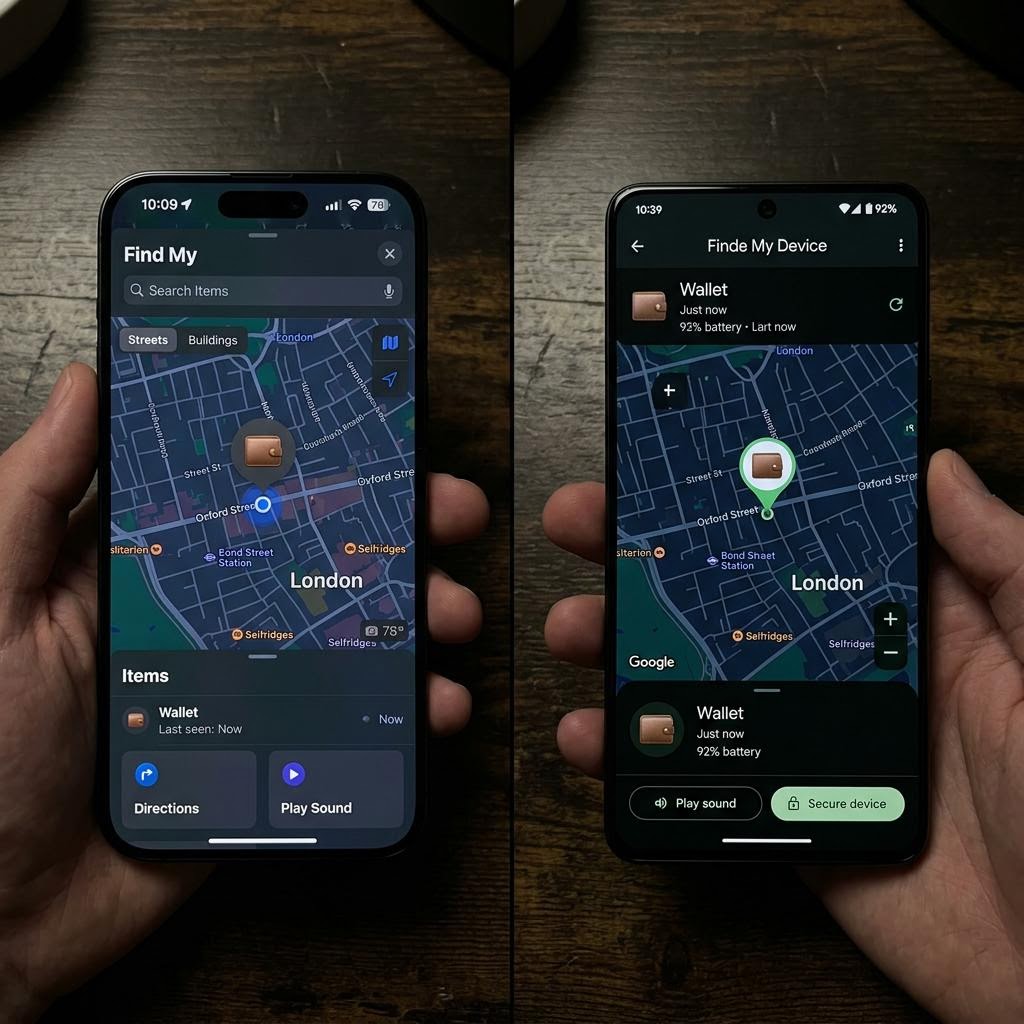
Most card trackers are designed for one network. Chipolo sells separate models: Card Spot for Apple Find My, ONE Point for Google Find Hub. You buy one, commit to an ecosystem, and if you switch phones or share a household, you start over.
InCard Finder selects its network at setup. If you want to switch — you upgraded from iPhone to Android, or you want your partner to be able to find it too — a factory reset reassigns it to the other network. One tracker, one purchase, either network.
This matters more than it sounds. Crowd-sourced tracking relies on network density. Both Apple Find My and Google Find Hub run on large, densely distributed device networks. Both are dense enough in urban areas to locate a tracker within minutes. The dual-network flexibility means you are not betting your wallet's findability on a single ecosystem's local density.
No extra app is required. No InCard account. Once set up, you use the native Find My app (iPhone) or the native Find Hub app (Android) — whichever you already have.
→ Shop InCard Finder from $21.99 — available in single and multi-packs with no subscription required.
How It Compares to Other Card Trackers
Here the honest answer is: the competition is real, and the trade-offs vary.
| Tracker | Thickness | Network | Battery | Waterproof | Price |
|---|---|---|---|---|---|
| InCard Finder | 1.7mm | Apple Find My OR Google Find Hub | Up to 5 yrs (Google) / 3 yrs (Apple), sealed | IP68 | From $21.99 |
| Chipolo Card Spot | 2.4mm | Apple Find My only | ~2 yrs, sealed | IPX5 | ~$35 |
| Pebblebee Card | 2.8mm | Apple Find My OR Google Find Hub | ~12 months/charge, USB-C | IPX6 | ~$35 |
| Apple AirTag | 8.0mm (disc) | Apple Find My only | ~1 yr, CR2032 | IP67 | ~$29 |
| Tile Slim | 2.4mm | Tile proprietary network | ~3 yrs, sealed (non-replaceable) | IP67 | ~$35 |
What this table means in plain language:
- AirTag has Precision Finding via UWB — the only tracker here with that feature. But it is 8mm thick, iPhone-only, and will not lie flat in a wallet. That is a real disqualifier for this use case.
- Chipolo is thinner than it used to be but still 2.4mm, Apple-only, and IPX5 (splash-resistant, not submersion-rated). See our full Chipolo comparison.
- Pebblebee is dual-network like InCard Finder, which is genuinely good. The trade-off is 2.8mm thickness and a rechargeable battery — every 12 months or so, you need to find and use the wireless charging pad. For a tracker that lives permanently in a wallet, that is a point of friction worth considering. Pebblebee's per-charge convenience is real; so is the risk of forgetting.
- Tile Slim uses Tile's own proprietary network, which is meaningfully smaller than Find My or Find Hub. Smart Alerts and 30-day location history require a Tile Premium subscription. The battery is sealed; when it dies, the card is replaced. See our full Tile comparison.
For more context on the broader field: Best Wallet Tracker — our full comparison guide.
FAQ
Can I use an AirTag in my wallet if I buy a special wallet? Yes — there are wallets and cardholders with a dedicated AirTag slot. They hold the disc securely, but they add substantial thickness to the wallet itself. They also only work with iPhone. If you want something that actually lies flat like a card, you need a card-form tracker.
Does InCard Finder work with Android? Yes. At setup, you choose Apple Find My (iPhone/Mac) or Google Find Hub (Android). The tracker uses whichever network you select. A factory reset lets you switch networks if you change phones or ecosystems. No InCard app or account is required on either network.
How does crowd-sourced tracking work if there's no GPS? The tracker broadcasts a Bluetooth signal continuously. When any nearby phone — belonging to a stranger — passes within range, it anonymously and encrypted sends the tracker's location to the network (Apple or Google). You see that location update in your Find My or Find Hub app. In populated areas, updates happen within minutes. Your location is end-to-end encrypted; neither InCard, Apple, nor Google can see it.
What happens to InCard Finder if it gets wet? InCard Finder is IP68 rated — tested to 1.5 metres of fresh water for 30 minutes. A washing machine cycle, rain, or a puddle will not damage it. Note: this rating applies to the Finder specifically. The Tagigo tag is not waterproof.
The Short Version
AirTag is a good tracker in the wrong shape for a wallet. It is 8mm thick by design, and that will not change. If your goal is a tracker that lives inside a standard wallet, lies flat, and works whether you have an iPhone or an Android phone, the InCard Finder is the only card-form option that checks all three boxes — dual-network, 1.7mm, IP68, with a sealed battery rated to five years.
→ See InCard Finder specs and order options at myincard.com